
The gaming industry remains one of the largest and most profitable entertainment sectors, but recent years have been turbulent. After a sharp surge during the pandemic, the market has faced widespread layoffs, rising costs, and increased caution among major publishers. Against this backdrop, independent developers are playing an increasingly prominent role in shaping the industry’s future.
After the pandemic boom
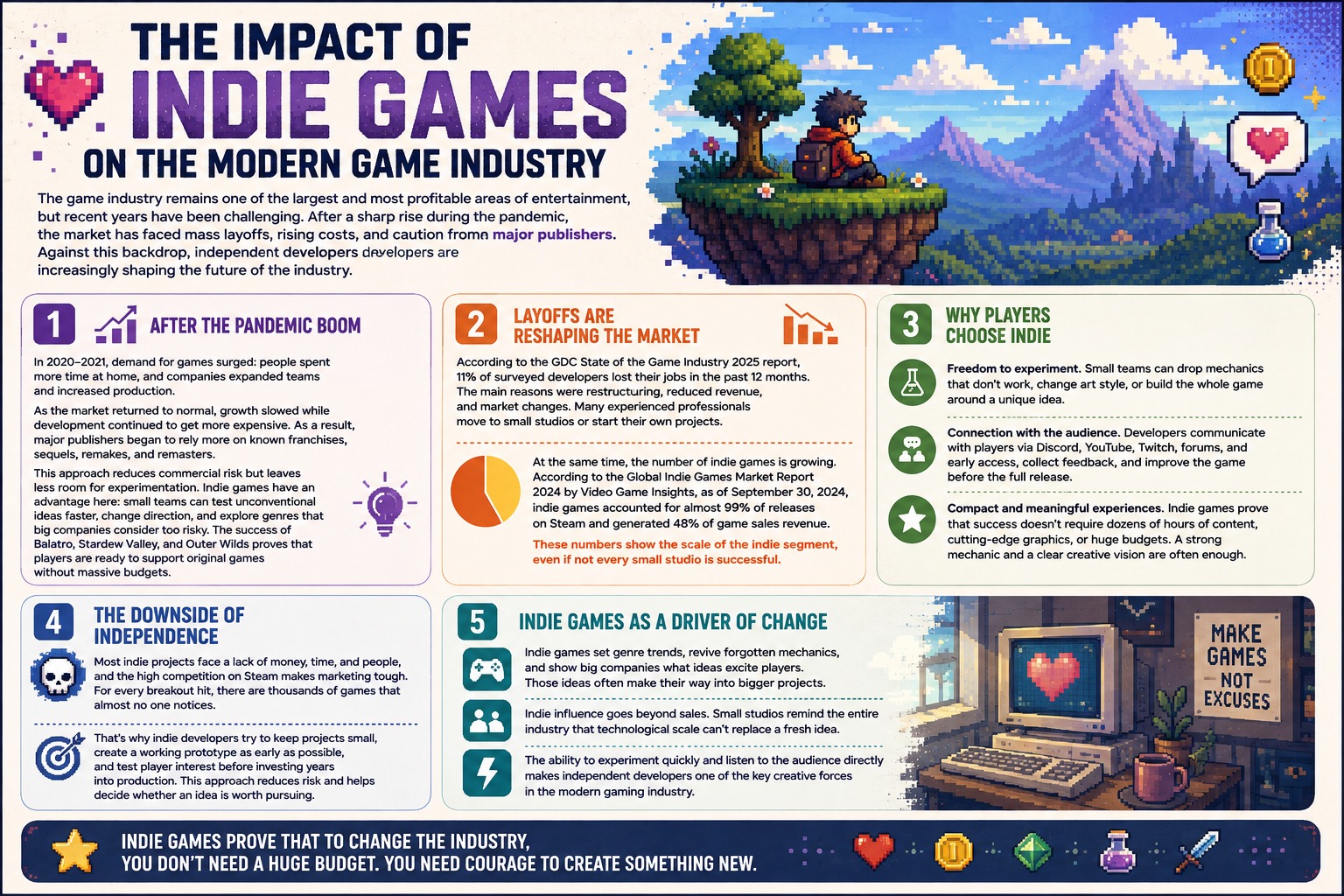
In 2020–2021, demand for games skyrocketed as people spent more time at home, prompting companies to expand their teams and ramp up production. As the market began returning to its pre-pandemic pace, growth slowed while development costs continued to climb. In response, major publishers began doubling down on established franchises, sequels, remakes, and remasters.
This approach reduces financial risk but leaves less room for experimentation. That’s where indie games have a clear edge: small teams can test unconventional ideas faster, pivot during development, and explore genres that larger companies consider too risky. The success of Balatro, Stardew Valley, and Outer Wilds proves that players are willing to support original projects that don’t rely on massive budgets.
Layoffs are reshaping the market
According to the GDC State of the Game Industry 2025 report, 11% of surveyed developers lost their jobs in the previous 12 months, with restructuring, declining revenues, and market shifts cited as the leading causes. Many experienced professionals, after being laid off, have moved to smaller studios or launched their own projects.
At the same time, the number of independent games continues to grow. According to the Global Indie Games Market Report 2024 by Video Game Insights, indie titles accounted for nearly 99% of releases on Steam by September 30, 2024, and generated 48% of game sales revenue. These figures don’t mean every small studio is thriving, but they clearly illustrate the sheer scale of the independent segment.
Why players choose indie
The biggest advantage of indie development is creative freedom. A small team can more easily drop a mechanic that isn’t working, rethink an art style, or build an entire game around a single unusual concept — the kind of ideas that major publishers would likely reject at the planning stage.
The connection with players also matters. Developers engage directly with their audiences through Discord, YouTube, Twitch, forums, and early access, gathering feedback and refining their games before a full release. As a result, the audience becomes more than just a customer — they become an active participant in the project’s development.
Indie games are also rekindling interest in compact formats. A game doesn’t need to offer dozens of hours of content, a sprawling open world, or cutting-edge graphics. Sometimes all it takes is a strong core mechanic, a distinctive visual style, and a clear creative vision.
The other side of independence
That said, indie development is far from the romanticized idea of total creative freedom. Most projects face serious constraints — limited money, time, and manpower — and fierce competition on Steam makes visibility a constant challenge. For every breakout success, there are thousands of games that barely register with players.
This is why experienced indie developers focus on keeping the scope of their projects manageable, building a working prototype as early as possible, and gauging player interest before committing years to production. This approach reduces risk and helps teams quickly determine whether an idea is worth pursuing further.
Indie as a driver of change
Independent games can no longer be considered the fringes of the industry. They set genre trends, revive forgotten mechanics, and show larger companies which ideas resonate with players. Successful solutions from indie titles often find their way into bigger-budget productions as well.
The influence of indie goes beyond sales figures. Small studios remind the entire industry that technological scale is no substitute for a fresh idea. Their ability to experiment quickly and stay closely connected to their audience makes independent developers one of the most important creative forces in the modern gaming industry.